Sunday, October 21, 2012

Yes, but what about Common Core?


Some concerns teachers have when it comes to re-imagining curriculum and instruction is the issue of standards. The textbooks schools have adopted are "research based" and "align to the standards," so teachers find these texts to be a reliable way to "cover" the state standards. This blog has been an attempt to show how to break away from the textbook not as a way to ignore state standards but as a way of putting global awareness and issue of democracy at the center of education rather than a subject or a standard. The literacy skills can be taught using any material, but "any" material does not teach students how to critical engage and participate in the world.

Here are a few of the new Common Core ELA standards for reading literature and informational texts:

Cite the textual evidence that most strongly supports an analysis of what the text says explicitly as well as inferences drawn from the text.

Determine a central idea of a text and analyze its development over the course of the text, including its relationship to supporting ideas; provide an objective summary of the text.

Analyze how a text makes connections among and distinctions between individuals, ideas, or events (e.g., through comparisons, analogies, or categories).

Analyze how particular lines of dialogue or incidents in a story or drama propel the action, reveal aspects of a character, or provoke a decision.

Compare and contrast the structure of two or more texts and analyze how the differing structure of each text contributes to its meaning and style.

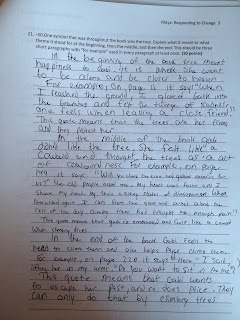
And here is the summative reading assessment for the unit. You will see how students demonstrate their ability to read literature and informational texts or to meet the standards as stated above. I think the key is to ask questions that provide students with an opportunity to demonstrate their learning. As I evaluated these assessments, I certainly saw places for further instruction. I can do a mini-lesson on using the transition "according to____" so that students know how to name their sources. Because I worked with them, I can see the sources they are integrating into their responses, and I can see how they are trying to cite examples in their responses, but there is room for more specific support and sourcing. That said, you can see how students are  analyzing dialogue to show how it propels action or reveal characterization. You can see how students are making connections among and distinctions between individual, ideas or events. 


Literary Elements: 

Central idea:


Textual evidence and connections:


Saturday, October 20, 2012

Preparing for Writing Workshop

Next week, we will begin to render our research into a multigenre project.


A multigenre paper arises from research, experience, and imagination. It is not an uninterrupted, expository monolog nor a seamless narrative nor a collection of poems. A multigenre paper is composed of many genres and subgenres, each piece self-contained, making a point of its own, yet connected by theme or topic and sometimes by language, images and content. In addition to many genres, a multigenre paper may also contain many voices, not just the author's. The trick is to make such a paper hang together. (x-xi)
Thus, students will take their research and their imagination and render that information anew. This project is a collection of five genres with a few organizing pieces: cover page, table of contents, letter to the reader, 4 genres, a concluding genre, and endnotes.

Our class, then, will need to take the form of a a writing workshop, which will also be the setting of our next unit: Writing and the Media. I set up a wall of sources. As students begin to write, they will be learning, so naturally, more questions about their topic begin to arise; therefore,  I gathered some sources on our "Source Wall."


Next, students will be working on different types of genres, and they have the freedom to select genres that they think will capture an idea or point of view or voice they want to bring into their project. Therefore, I have created a "Genre Wall" with examples and some "how-to" for different genres.  I anticipate this wall growing as students' imagine new genres.

 Next, I have created a wall of sample multigenre projects for students to see how to organize the different genres into some sort of frame, though they will discover that their project is never whole or finished.

Writing Workshop: For a strong argument for what the writing workshop can do for democratic pedagogy, read Powerful Writing, Responsible Teaching by Timothy J. Lensmire: 


Powerful Writing, Responsible Teaching (Critical Issues in Curriculum)

To get the workshop going, I have created a three-part framework common in many writing workshops: lesson time, writing time, and sharing time.  Lesson time is the responsibility of the teacher or, if you have teacher-for-a-day projects as I will talk about later, it might be a student teaching some lesson about a writing strategy or genre. Next, students move to writing time -- a no walk, no talk time -- for students to settle in and write. Be sure students have the genre materials then need along with pencils, pens, a thesaurus, dictionary, and any writing guides you have at the writing tables before you start this time. You may try soft music as a signal that sacred writing time.  Finally, sharing time might be 1) peer reading when they "like" or "question" their peers' writing or 2) a whole group sharing like "author's chair" (http://www.oaklandwrites.org/documents/writing-process/IdeasSuccessAuthorsChair.pdf). Here is that PDF pasted: 

IDEAS FOR A SUCCESSFUL “AUTHOR’S CHAIR”
Preparing:
*Set clear norms for classroom behavior and expectations before you start. Ex: During 
Author’s Chair all pens/pencils are down, heads are up off desks, etc.
*Pre-select student to read – ask student ahead of time – you may choose someone who 
has demonstrated a skill from the day’s writing lesson well.
*Keep track of who has been in the author’s chair – you may want to make this visible to 
the students as well.
*Teach students how to read their work loudly, slowly, and clearly. You may want to let 
readers practice before reading to the class.
*Model how to be in the author’s chair for students
*Encourage students to read their own work
*Optional – having a microphone is fun and can work well

Facilitating:
*You may focus the class before they listen to the reader: tell them what to pay attention to 
in the piece.  
*The audience can listen carefully and give a silent thumbs up when they hear a particular 
skill that the class is studying at that time. Ex: metaphor or simile, transition words or other 
vocabulary, etc.
*After students have listened to the piece, you can guide their responses with sentence 
starters Ex: “When you described ____________ I felt….” Or  “I thought it was interesting 
when…”
*Give students a menu of ways to respond to the writing: Ex: personal connection, 
academic connection, compliment, etc.
*As students are making comments about the piece they just listened to, write them down 
on the board or on a piece of paper. Read these back to the author/class.
*When the reader has finished sharing the writing, and listening to the comments of the 
group, invite him/her to share how it felt to share and to listen to the comments afterwards.

Results:
*The sense of community is reinforced
*Writers know that others value what they have to say
*Writers have an opportunity to hear their own work
*Students know what everyone else is writing
*Students practice active listening
*Students hear new words
*Writers build confidence through the comments afterwards
*Writers see how the techniques they hear used and complimented might apply to their 
own writing
*Writers find mistakes when they hear themselves and their manuscripts
*Teachers have brief, on the spot opportunities for on the spot lessons
*A foundation has been laid for the transition to peer conferencing


Starting the Action Plan


Action Day!

On Fridays, perhaps every Friday or perhaps alternate Fridays, we will take action with our reading and writing. We are still imagining what this will look like, but we imagine it will be working on the website, developing fundraisers, and writing books to send to our sister school in Guatemala.

The students in our class are so smart and so compassionate that they want to do something with all that we are learning. We read for knowledge, and we write to learn.. All language is rhetoric -- using the symbol of language to inform, persuade, and/or entertain, so let's do something with our writing that participates and critically engages in the world.

Today, we typed our business letters about Chicza, a bio-degradable gum made by chicleros in Central America. Because we cannot buy this gum in America, students wrote to Whole Foods to persuade them to take steps to bring this gum to their stores. (We did research on the gum industry and the chiclero co-operatives earlier in the year.) Why? Students like to chew gum, but they realize (because of their inquiry) that all the gum they consume is synthetic and not biodegradable, so it is accumulating in our environment; they also realize why schools "ban" gum -- it costs a lot to remove gum from carpet, and carpeting costs a lot of money. 

During our study of the Maya and the Guatemalan Civil War and genocide, students learned the importance of literacy in other countries when it comes to human rights and fighting for human rights. They want to raise the literacy rate in Guatemala, so today we learned about a school in Guatemala that is doing really good work with children in their community. They would like to build a relationship with us, and I think can be a positive example of globalization; we can learn about the lives of other children in the world, and they can learn about ours. Thus, we started an Action Plan to brainstorm ideas. 


Thursday, October 18, 2012

Skim, Scan, Note, and Render

Today we reviewed issues of reliablility with sources. Students argued answers to the quiz from yesterday trying to decipher which sources would be the most reliable and why. We came to the conclusion that all sources have some issues of unreliablity because of bias or point of view. 

Next, we talked about strategies for determining the value of a source to our research and then how to go about taking effective notes. Skimming is the first step to determining if the source is useful: read the title, the headings, the first paragraph, and the last paragraph, and then look at pictures and captions. If the information seems helpful, then prepare to take notes. Scan for topic-specific terms that you may need to look up. Write some of those terms in the left column and add definitions  Then read more closely for the 5Ws.  You may be focusing more on what or why depending on your research topic. When you find a sentence that is really important, write down the entire sentence with quotation marks and the page number. 

I gave students a short article from Smithsonian Magazine: http://www.smithsonianmag.com/history-archaeology/Digs-Paper-Trail.html. Students highlighted what they would skim in one color and then highlight the 5Ws in another color. Next, students completed a research log -- topic-specific vocabulary, what and why, and then the summary. 

Because the research logs are in preparation for the multigenre research project, I asked students to use the information from their research log and write a poem (a haiku or a couplet). I wanted students to see how the information can be rendered differently to show it in a new way. Next, I read the poem I wrote: 

A Human Rights Breakthrough in Guatemala


1980
Bodies.
The burns on by body are not enough?
The scars from the rape are not enough?
Exhumed bodies are not enough?
2005
Archives.
Boxes of evidence?
Pieces of paper?
Assassinations, disappearances, “special cases”?
Is that what you need to investigate --
To bring them to justice?
I have paper for you.
Here is a picture of my family --
Dead because they are Mayan.

Justice
for
the bodies.


One students said, "You are not Mayan, Mrs. Donovan. What is this?" Right, so I was so glad someone said this so that I could talk about rendering a text to show something new -- a new point of view and sentiment out of the spaces from another. I talked to students how I used more than one source for this poem and how the "topic-specific" words were central to the poem's mood and tone. One source was Tree Girl as I spoke from the point of view of an imagined rape victim from chapter nine. I also appropriated part of Discovering Dominga as I am thinking of the memorial museum in Rabinal, and then I am using the words and facts from the Smithsonian article. 

Next, I introduced students to Google Books. Not all books are available on Google Books, but many are (or at least portions are available). Google Books scans the books for you and highlights search terms. Books are reliable sources because they are published, but we still have to be aware of the copyright, the author and bias. 

Finally, we went to the computer lab to do another research log with a Google Books source. 

Wednesday, October 17, 2012

Reliable Sources

Today, we continued our inquiry project. Students are asking questions related to life of the Maya.

Before we went to the computer lab, we did a mini-lesson on source reliability. This lesson has two goals: 1) to learn a few key elements of a website to consider when selecting sources; and 2) to increase awareness of reliability within different genres to consider when doing research using the same elements of reliability?  In this mini-lesson, we discussed some elements of the source to consider when doing web searches:

1. copyright: is the information up to date; is the website monitored
2. credibility of the source: Can you look up information about the author; are the authors professionals, education and/or experts; can the information be checked on another website; are there links to related websites and articles?
3. domain: .com, .net, .edu, and .gov; here we talked a little bit about Wikipedia -- what is good and problematic about this source. For our discussion, what seems most useful is how Wikipedia is a source that can be updated at any time;  as a topic develops over time, this website can be revised whereas a book that was published a year ago will not have information about more recent developments. For example, the massacre as Srebrenica was in the 90s but just yesterday Serb leader Radovan Karadzic testified at the war crime tribunal a The Hague. On the other hand, we do not know the credentials, expertise, or bias of the writer doing the editing.
4. bias: considering if the website is "anti" or "pro" and looking for the "other" side

We looked at three websites and considered the above elements when selecting which website would be the most reliable and why.

Then, I gave students a 4-question quiz asking them to consider which sources are most reliable in four categories and argue why; what is most important is that students' reasoning includes something about the copyright, the credibility of the writer, the possible domain, and the possibility of bias:

1. websites -- articles written by students, government publications, blog, official sites like the National Park Service
2. newspapers or articles -- editorial, governmental publication, tabloid magazine
3. books/textbooks -- books copyrighted before 1950s, fiction, published by an organization, current books
4. diaries, journals, letters, and interviews -- letter written by a person who witnessed an event, writing from someone who hear about an event

When we went to the computer lab today, the goal was to find one more source (their second) with a domain of .edu, .org. or .gov and to complete a research log (their second). Students completed their source card -- author, title, website, copyright, and date found . We talked about what to do if you can't find the date (write n.d.) and what if no author is credited with the text on the website (use the title of the website). Each research log should match the source card; in other words, research log #2 would be from the source on source card #2.

While students were researching, we ( I have a great student teacher who started this week) noticed they were having difficulty determining whether or not the website would be good for their research question (now that they knew if it was reliable). So tomorrow, we will do a mini-lesson on skimming and scanning.

Interesting conversation today:
Student: What if there is only one website about my topic?
Teacher: What do you mean?
Student: There is nothing on my topic; they keep talking about something else.
Teacher: What is your topic and question?
Student: Truth Commissions and what it did for Guatemala
Teacher: Oh, let's see....you are on a page about the Memory of Silence.
Student: Yeah, so it's not about the Truth Commission
Teacher: Okay, so what is the Truth Commission?
Student: They investigated the genocide but what is this?
Teacher: This is the report, the findings the Truth Commission came up with after their investigation, so this topic is related to your question.  Let's just read the conclusion because it is a long document. Look at the headings, what's bolded: .rape, disappearance, anti-communism. So the T.C. -- you can abbreviate it in your notes -- looked into all these charges that victims or others made to see what is "true" -- basically trying to find out what really happened.
Student: Oh....and this is what they found was "true"?
Teacher: Right, but it also will say if they found something wasn't quite true or happened differently than what people said. Remember, we Tree Girl that showed the rape, disappearance, and anti-communist argument, but that was a novel, so now we can see what part of Tree Girl connects to T.C  ...but after you read this part, it would be great to find out what recommendations the Commission had, too -- that's later in the document.

at the end of class...
Teacher: Find some interesting details?
Student: Oh yeah!

Tuesday, October 16, 2012

Students to Present at a Youth Summit


Our students have been invited to share their "power" at the Youth Voice in Action Summit: http://ydsummit.wordpress.com/

Here is a little about the summit:

Youth Voice in Action 3rdAnnual Youth Development Summit
Saturday, November 3, 2012
Uplift Community High School

Do you believe in the power of young people to create change? Do you work with a youth development organization or collaborate with powerful youth leaders? If this sounds like you, we want you and the young people you work with to facilitate a workshop at the 3rd Annual Youth Development Summit.

The 2012 Youth Development Summit committee is now accepting applications for presenters. This event is an exciting  opportunity for youth development and community activists to come together, share their expertise, learn from one another and support youth-led social change.

We are looking for hands-on, activity-based workshops to highlight Youth Voice in Action.  These workshops should be of interest to youth workers, educators, community organizers, social workers, youth and youth advocates.

Here is our proposal:

Session Title: Co-ops and Cooperation: Reaching out to the Modern Maya
Session Description (30 word or less description of the workshop as it should appear in the program book): Students from Winston Junior High talk about critical engagement and participation in global projects, specifically how they are supporting the modern Maya as they nurtured indigenous traditions a midst globalization and a genocide.
Session Proposal (100-150 words, must discuss how the session aligns with the conference theme and focus area) : These young people show the power they have to create change, but how that power is enhanced with inquiry and literacy. The context of any social problem is complex; there are multiple participants, and the problem is constantly evolving. Students will show the range of texts and documentaries they saw to understand the context of globalization. They will share the letters they wrote to bring Chicza gum to America, in support of the chiclero cooperatives and the project they are starting to sponsor a child’s education at a school in Chimaltenango. When students read and write about a problem, they are asking questions and imagining solutions. In imagination comes the realization that they can come up with the solutions and take steps to bring about change. Yes, an adult can support them, but they don’t really need us.  Here is a link to a new article about the project: http://www.lombardian.info/9743.html and the website for the project including student work: http://treegir.blogspot.com/. 

Doing "Independent" Inquiry

Today we began our first "independent" inquiry project. I put it in quotes because no inquiry is actually independent, but I want to note that students are now doing the work of inquiry on their own as an extension of that which we have been doing as a class.

The last page of the synthesis exam that students just completed asked them two questions that will lead to the next phase of our work: 1) what sort of action can we take as a class to connect what we learned to other human beings across the globe and 2) what questions have come up during our study that you want to learn more about. These two questions helped me to shape the next phase of our class.  To the first question, students agreed that education is the best tool the Maya had for responding for change, and that education can take many forms whether it is formal education or learning how to adapt traditional methods to changing circumstances; therefore, students agreed that the action they want to take is to develop a relationship with a school in Guatemala. For this, we will do an action plan. To the second question, I saw the kinds of topics students were interested in learning more about and developed a multigenre inquiry project for them to 1) research their topic, 2) develop a research question, and 3) synthesize their findings into a multigenre project where they show different points of view and information from several genres.

Last night, I asked students to write a half page about the topic they chose and why. Today, we talked about how to go from researching a topic to doing inquiry to answer a question. Students wrote their initial research question and went to our computer lab to do an initial search for sources. After previewing several sources, students selected one, completed a source information sheet, and then wrote their notes on their research log. The source sheet and research log were labeled #1. Questions that emerged were related to who authored these sources, where can we find copyright dates, how do I change my search terms to get better results? This was a more effective way of teaching about sourcing than lecturing on it, and tomorrow, we will talk more about reliability of sources before doing the research log #2.

Some interesting content-related questions emerged:
Student: Wait, Mrs. Donovan, so was the United Fruit Company bad?
Me: What makes you say that?
Student: Here, it says they took over the Maya land and forced them into labor, and for people who didn't work, they passed "vagrant laws" punishing them. So were they bad?
Me: Well, the people in America were able to get affordable bananas? Is it that good or bad? So what am I saying?
Student: It depends on where you are living, huh?
Me: Point of view has something to do with it, yes. I can't wait to read your paper!

Thursday, October 4, 2012

Endings: Resisting Modernity at 16

Endings: We read chapter 15 in Tree Girl. We started with the idea of "home" and what makes us feel at home. Students did a little journal-ing about the word "home."   This is a theme in the last chapter, but the book really examines how globalization or big business redefines notions of home for people of the world, and Ben Mikaelsen, the author of Tree Girl,  represents this logic.

At the beginning of the book, we learned that Gabi, the protagonist,felt at home high in the trees of the Guatemalan Highlands, but by the end of the book, she won't climb trees (and most trees were destroyed in the "Scorched Earth Policy");  her "home"  has been destroyed by the government soldiers,   and nearly all her family has been massacred. The author has to address this issue of physical loss but also a figurative loss of tradition and ancestral remains in the last chapter of the book. Gabi is faced with either going to America, fighting with the guerrillas, or staying in the refugee camp to be a teacher, but she doesn't see any of these options as helping her re-establish her "home." Because of modernity such as technology, development, and expansion of business in other countries, Gabi's home has been destroyed; she is repulsed by what America represents and values as she says: "It seemed very sad to me to think that some would so quickly trade the rich traditions of our Mayan past for the modern conveniences of a future America" (213). What will she do?  Does she even have a choice about her future? Will she ever climb a tree again? Will little Alicia ever speak?

In a time of consumerism and individualism, students bear witness to Gabi's testimony and worldview considering the impact of globalization in both individuals and the collective peoples they represent.

The next step is for students to synthesize the past few weeks of inquiry. How can teachers assess this process of knowing? How can we measure students knowledge and learning? Here, I see knowledge as that which students can read; it is information. On the other had, I see what students have learned as being much more complex, more of an interpretation, and even the sort of questions that have emerged -- all evidence of learning. And so, how can we assess this?  The unit or the learning cannot be multiple choice or concrete per se but rather must be consistent with the concept of genocide, which is rhetorical in nature, and inquiry, and narrative inquiry, which is all about opening spaces for further inquiry. Developing the "test," then, was a challenge for me. I had to resist ways of testing that have been part of education reform since I began teaching over eight years ago, methods anchored in the tradition of English textbooks (e.g.,multiple choice, matching,  literary terms, and other concrete ways of knowing). Instead, I wanted to use the literary terms as a tool of analysis considering authorial strategies of artistic representation. The study guide was useful in helping students learn the literary tools in context and a way to alert students to how Mikaelsen was representing social values or using dialogue to show the multitude of voices the preceded and continue to impact the modern Maya. Thus, in this final assessment, students will use their notes from research of images and videos I took while in Guatemala in 2012, Tree Girl, their study guide from Tree Girl, and then notes from Discovering Dominga, and  When Mountains Tremble to tell me about their experience bearing witness to not only Maya history but our (U.S.) own.

Tuesday, October 2, 2012

Troubling Representation


We started class by retelling and summarizing the second part of When Mountains Tremble. Students first wrote one sentence stating the difference between retelling and summarizing. Next, students used the graphic organizer from yesterday to retell the events of the documentary followed by a summary. While students wrote, I walked around the room to give immediate feedback. Summarizing proved to be a challenge because we have to take a step back from the details and consider what the author or filmmaker's purpose is in presenting the details as she did -- the sequence, the subjects, and the storytelling techniques.


Next, we got into partners and wrote responses to the film as a way of synthesizing what we have been learning and to practice using support in our responses. Students answered 1) what was the "business" relationship between Guatemala and the US during the war in Guatemala and what was its impact on the people; 2) compare how the guerrillas were portrayed in the documentary versus the novel and talk about which seems more "truthful" or accurate and why; and 3) rate the novel, Tree Girl, Discovering Dominga, and When Mountains Tremble  as to which was more effective in several categories. Today was really important because students had time to synthesize what they have been learning thus far. They talked it out with partners, clarified understanding, and began to get the idea of troubling representations of history. Were the guerrillas good or bad? Did the Mayas contribute to the violence, or were they innocent? What questions can the exhumation of the clandestine graves answer, and what do we still need to know? Finally, I asked students to rate the representation of the Maya, Guerrillas, and the U.S. in Tree Girl,  Discovering Dominga,  and When Mountains Tremble.   This rating scale is meant to be a bit ironic. Each text does something different, and not text can say it all  -- realizing that narratives open spaces for further inquiry is the lesson here. Some students gave each box a three instead of using it like a rating scale saying: "I needed to read and see all three to understand what was going on, and I still have questions."

Finally, students who were up-to-date on the study guide for Tree Girl got into a discussion group with me to discuss the text and practice "building on the ideas of others." This was a good time to reinforce the practice of going to the text for support or for clarification. Students who needed more time to work on their study guides had class time to do some reading. In our school, about one third of the students can stay current with independent work or homework, so if you have a teaching assistant or co-teacher, you can do some grouping to support students who need more encouragement or even just a quiet place to read. These students also need the experience of "building on ideas of others," so some chapters should be read and discussed whole class, too.

Monday, October 1, 2012

Retelling, Summarizing, and Point of View


We discussed and took notes on the difference between summarizing and retelling and then we practiced retelling part 1 of When Mountains Tremble followed by a summary. The guide we used for the retelling was the story map we created last class.  The summary piece is what gets at the argument the filmmaker is trying to make and how she is trying to make it.

We discussed how documentary movie making requires access to different points of view. Students watched the remainder of the documentary using a graphic organizer with quotes from different subjects in the film: Maya, guerrillas, Guatemalan government officials and United States officials. Students see how the filmmaker presents each subject's point of view on various topics. For example, we see guerrillas visiting a Mayan canton asking for their support, then we see soldiers throwing anti-guerrilla pamphlets out of helicopters, and then we see a young Mayan girl talking about her decision to join the guerrilla movement before we listen to an interview with  a Guatemalan general talking about their strategy to remove the people supporting the guerrillas: the Maya. As students watch the documentary, they sequence the quotes noting how the filmmaker uses footage, stock footage, re-enactment, and interviews from various subjects to make her argument about the civil war as a genocide supported by the U.S. government.

Tree Girl Study Guide Responses


Friday, September 28, 2012

Storytelling and Representation: When Mountains Tremble

Documentaries, like novels, are a representation. We can learn a lot from documentaries, but we have to understand that a documentary is storytelling and be aware that a filmmaker (instead of an author) is representing an event using storytelling techniques. Below is a list of key terms students will use when analyzing the storytelling of the documentary When Mountains Tremble, but before showing the film elicit these techniques by discussing/reviewing Discovering Dominga: 

Image

The next step in today's class was to talk about filmmaking. Soon, we will have iPads, which means we will have tools for making our our documentaries at some point. Thus, we started class with an "imagine-if" scenario. Here is an idea from http://www.pbs.org/pov/behindthelens/lessonplan1.php:

 MAKING A DOCUMENTARY ROLE PLAY


In this step students take on the role of being a filmmaker. Working in groups of 4 to 6, students should consider the following scenario:

In preparation for a community-wide open house, students and teachers at Anyburg Middle School decided that it would help people understand the school experience if each class recorded a video of a typical day. The school had a limited amount of video, sound, and lighting equipment, so staff worked out a schedule for each class to have the cameras for two days.

By chance, Ms. Perez's science class ended up with the cameras on days when students were doing test prep. The students didn't think that footage of them mostly reading, taking notes, and occasionally asking questions was representative of their normal, vibrant class with hands-on labs and real-world research problems. But that left them with a dilemma. Should they shoot what was actually happening in their class that day, or should they re-enact what would happen on a more typical day? To make things even more complicated, on the second day of their video shoot, someone accidentally knocked over a tray with test tubes and beakers. This had never happened in class before. Students disagreed about whether to leave in or edit out the footage of the accident and cleanup.


Ask students to discuss the following in their groups: In your view, in these circumstances, what production choices would a documentary filmmaker make and why? How about a Hollywood filmmaker? How about a reporter from a local television station? What would be the best representation of the class and why?

After giving students several minutes to discuss the questions, call the groups together to share responses. Help students make links between what they discussed and what they learned about documentaries and documentary filmmakers.

Note: There is no "right" answer. Even experienced documentary producers disagree about how best to convey "truth" and whether things like re-enactment are appropriate. The idea here is to get your students talking about what values are in play for each type of media-maker. The Hollywood filmmaker might be more concerned with drama, the news reporter more concerned with accuracy and what footage they can get during the ten minutes they are in the school, and the documentary maker might step back and ask what is most important for the community to understand about this class.

Next, we viewed the documentary When Mountains Tremble  looking for storytelling techniques  such as interviews, stock footage, voice-over, and re-enactments.

Students made a visual map of the choices the filmmaker made to tell the story noting the difference sources that the filmmaker wove together to tell a story with voices and images from many different points of view; however, those clips are selections made by the filmmaker to make an argument, so we have to think about what was not selected and be aware that a documentary is not neutral.

 Below are maps of the sequencing and subjects the filmmaker used to tell the first 45 minutes of When Mountains Tremble. The movie enters the conversation about Maya resilience, cooperation, and democracy with footage from guerrillas, soldiers, Maya, the United States, priests, and lawyers in 1982 along with archival footage from 1954 and one re-enactment. What Yates argues is that the United States was supporting a new version of democracy in Guatemala. Yates represents the United States as supporting a military dictatorship while the military is telling the people that they are supporting democracy, a democracy that allocates land for big business and forces Maya to work on business owned plantations of coffee and cotton in order to pay land taxes that have been Maya land for hundreds of years. Rather than an image of Maya remaining neutral in the war between the guerrillas and the government as we see in Tree Girl,  Yates represents the Maya as participants joining the guerrillas in taking up arms in the name of freedom. Students see the guerrillas and the Mayas depicted from a new point of view, which complicates the Western narrative of guerrillas as all evil. The idea of revolution is introduced to our study of the modern Maya. The sequencing map illustrates not only the complexity of documentary filmmaking but also the complexity of storytelling, of history. Thus is the messiness of democracy as well.


Image

Thursday, September 27, 2012

Refugees and Globalization

Today we read chapters ten and eleven of Tree Girl. The setting of chapter eleven was the refugee camp at San Miguel in Mexico. This chapter is helpful in understanding globalization and how not only the commodities or products in one country impact the economy and culture of another but how the political events or disasters also impact other nations.

I did some drawing on the whiteboard to illustrate the concept of a refugee. Some students did have some prior knowledge about refugee camps because they learned about the Lost Boys of Sudan last year.  I drew a group of people in one place, discussed situations that would make them disperse, and then talked about where the now refugees might go. Next, we talked about the impact a mass of people would have if they had to suddenly migrate to another town or state. What impact would that have on the people in the new place? What about the resources? Who would organize the relocation? What might be the conditions or conflicts a refugee could expect?  We talked a little bit about the Red Cross and humanitarian efforts, too because there is mention of a gringo handing out rice to the people -- both the gringo and rice prompted interesting conversation from the students: " Do the Maya even eat rice? I thought they were corn people." "Why is the gringo speaking in Spanish? Doesn't he know there are like 23 Maya languages?"

We did a large Socratic Seminar today. I developed questions for chapters  nine, ten, and eleven so that we could  practice "building on ideas of others" in discussions. (Earlier in the week, they tried this out in groups of four with some success.) As I posed questions, I gave students a chance to write down their responses (think), then share their responses with their neighbor (pair), and then share their ideas with the class. After a student shared, I asked, "Would anyone like to build on ___'s idea?" When a student raised a hand, I would first ask for them to restate or clarify their classmate's point before building on that idea. After a few times, I didn't need to prompt this and students running the discussion.  This was a great opportunity for students to name one another, celebrate ideas, and make connections -- beautiful.

Here are some of the questions we discussed in chapter eleven, 155-169. The first two questions are not useful for discussion, but it helped us clarify the setting for students who may not have been following the text. Questions 3-6 ask students to predict and analyze using support from the text.


1.  Describe the refugee camp at San Miguel.
2.  What was the first thing Gabriela did upon arriving?
3.  Do you predict Gabi will or will not find Alicia?Explain based on the setting and the authorial pattern you've notice in the plot.
4.  What were the social values -- altruistic, individualistic, competitive, cooperative --  of the refugee camp?  State at least two and give quotes from the text.
5.  Did Gabriela share the values of the rest of the camp? Why or why not? p. 162-165
6.  How did the camp experience impact Gabi's view on America? On her Maya culture? What does modernity mean to Gabi?

For the upcoming research project, students may want to learn more about refugee camps or refugees. Discovering Dominga is one source for that, but this book can be, too.


Wednesday, September 26, 2012

The Gorgon Effect


Today, we started with a lesson on Perseus and the Gorgon, Medusa, to create a metaphor about genocide. (Most students knew Perseus and Medusa from  Percy Jackson movies and books.) Inga Clendinnen, in Reading the Holocaust, calls this the "Gorgon effect":"The sickening of imagination and curiosity and the draining of will which afflicts so many of us when we try to look at the persons or processes implicated in [atrocities]."  She claims that we cannot afford being blinded  into silence or reverence by humanity's atrocities and, thus, from changing things.

Often times, people turn away from terrible things. We look away because it is unimaginable or unbelievable or even if we just feel like we can't make a difference. The gorgon petrifies the human in itself and its prey, or those who look into its eyes. However, because the students are just now thinking about what they might want to do with their lives or what kind of person they want to become, now is a good time to face the horrible and think about the choices we can make in our lives, how we can be agents of change. While it is difficult to know about genocide, it is more difficult to say, " I didn't know." Phillip Gourevitch, in We Wish to Inform You That Tomorrow We Will be Killed With Our Families, writes, "The best reason I have for looking closely into Rwanda's stories is that ignoring them makes me even more uncomfortable about existence and my place in it. The horror interests me only insofar as a precise memory of the offense is necessary to understand its legacy" (19). For Clendinnen and for Gourevitch, it is a politics of seeing: if we want to destroy the gorgon -- genocide -- we need to stare back and see the processes of genocide.


We read chapter nine of Tree Girl  out loud. In this chapter, Gabi has hid her sister Alicia and the baby she helped birth under a bush so that she could to go to a nearby market for food, a pueblo apparently untouched by the scorched earth policy of the Guatemalan army. There, she meets Mother Lopez, a nun who intends to help Gabi until the soldiers surround the market. Gaby runs and climbs a machichi tree, and from the branches, she bears witness to the soldiers' systematic massacre of every living being in the pueblo over a two-day period. This chapter is the most graphic chapter of the book, so after I read this, I ask students to journal a response to this question: Do you think the graphic nature of these chapters was necessary for a young adult book? Should history like this be retold or kept silent?  Is it more or less powerful in fiction than in a text book?  Why or why not?Students had a lot to say about this. I will post some pictures from their journals.


Chapter nine seems to be based off of the events at Dos Terres: Here is an episode from This American Life , which aired May 25, 2012; there are also updates as recently as September 25,2012.
http://www.thisamericanlife.org/radio-archives/episode/465/what-happened-at-dos-erres. Below is an ebook about the same story.


Finding Oscar: Massacre, Memory, and Justice in GuatemalaBy ProPublica